Want to know how to calculate moles? Need to convert grams to moles, or moles to grams? Then welcome! If you are looking for a tutor in Scotland, get in touch with us now, or start by viewing our tutors here!
What is a mole? What is a moles equation?
A mole, in chemistry, is how chemists define an amount of substance, useful when dealing with many different molecules reacting at once, for example any chemical reaction. The official International System of Units definition is that a mole is, “the amount of a chemical substance that contains exactly 6.02214076×10²³ (Avogadro’s constant) atoms, molecules, ions or electrons (constitutive particles), as of 20th May 2019. Prior to that, a mole was defined as the number of atoms in 12 grams of carbon-12 (an isotope of carbon).” That was a mouthful!
Why do Chemist use moles?
Why do Chemists use moles and why do you need to calculate it? It provides a useful metric when dealing with reactions, let’s look at any example:
Real Moles calculation example
“Let’s say you want to neutralise 10 g of hydrochloric acid (HCl in water) with some sodium hydroxide (NaOH). Now, you want the resulting solution to be perfectly neutral, so you don’t want to add too much or to little NaOH, making it too basic or acidic respectively. It is therefore useful to find out exactly how many molecules of HCl are in the solution. This is where moles come in handy. To know how to calculate moles, the equation is:
mole = mass / molecular weight"
How to calculate moles – create a moles to grams converter
Let’s do any example on how we can convert moles to grams, or grams to moles.
Real moles to grams example
“We know we have 10 g of HCl, and it has a molecular weight of 36.5 g / mol. Lets plug these numbers into the above equation:
mole = 10 / 36.5 = 0.27 moles = 1.626×10^23 molecules of HCl
We can work out the number of molecules by timesing the moles by Avogadro’s constant above. Now we know the amount of molecules of HCl we have, and, since the reaction is 1:1, we need the exact same number of molecules of NaOH to neutralise it. As we need to find the mass of NaOH to add, lets quickly rearrange the equation:
mole = molecular weight / mass (mulitply both sides by mass)
mole * mass = molecular weight (divide both sides by mole)
mass = molecular weight / mole
As 1.626×10²³ molecules of NaOH is also equal to 0.27 moles, and we know that the molecular weight of NaOH is 40, we can use these numbers to get:
mass = 40 / 0.27 = 10.8 g
So we now know we need 10.8 g of NaOH to exactly neutralise our amount of hydrochloric acid.”
Mole Formula Cheat Sheet
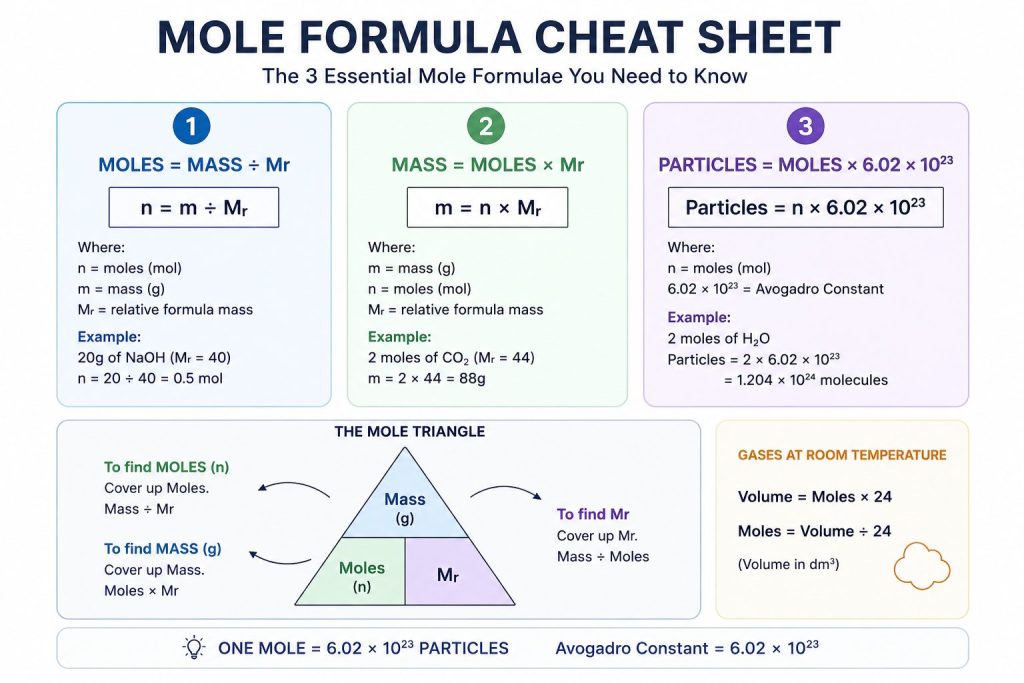
What Is a Mole in Chemistry?
A mole is a unit used in chemistry to measure the amount of a substance. One mole contains:
6.02 × 10²³ particles
This number is known as the Avogadro Constant.
The Three Essential Mole Formulae
1. Moles = Mass ÷ Relative Formula Mass
Formula
n = m ÷ Mr
Where:
- n = number of moles
- m = mass (g)
- Mr = relative formula mass
Example
How many moles are in 20g of sodium hydroxide (NaOH)?
Mr of NaOH:
- Na = 23
- O = 16
- H = 1
Mr = 40
Calculation:
20 ÷ 40 = 0.5 moles
Answer: 0.5 mol
2. Mass = Moles × Relative Formula Mass
Formula
m = n × Mr
Where:
- m = mass (g)
- n = moles
- Mr = relative formula mass
Example
Calculate the mass of 2 moles of carbon dioxide (CO₂).
Mr of CO₂:
12 + 16 + 16 = 44
Calculation:
2 × 44 = 88g
Answer: 88g
3. Number of Particles = Moles × Avogadro Constant
Formula
Particles = n × 6.02 × 10²³
Example
How many molecules are in 2 moles of water?
Calculation:
2 × 6.02 × 10²³
= 1.204 × 10²⁴ molecules
Mole Calculation Triangle
          Mass (g)
        -----------
       |           |
       |           |
 Moles (n)      Mr
To Find Moles
Cover Moles
Mass ÷ Mr
To Find Mass
Cover Mass
Moles × Mr
To Find Mr
Cover Mr
Mass ÷ Moles
Volume Formula (For Gases)
At room temperature and pressure:
Formula
Volume = Moles × 24
or
Moles = Volume ÷ 24
Where volume is measured in dm³.
Example
Calculate the volume occupied by 2 moles of oxygen.
2 × 24 = 48 dm³
Concentration Formula
Formula
Concentration = Moles ÷ Volume
or
c = n ÷ v
Where:
- c = concentration (mol/dm³)
- n = moles
- v = volume (dm³)
Example
0.5 moles dissolved in 2 dm³
0.5 ÷ 2 = 0.25 mol/dm³
Common Relative Atomic Masses to Remember
| Element | Symbol | Relative Atomic Mass |
|---|---|---|
| Hydrogen | H | 1 |
| Carbon | C | 12 |
| Nitrogen | N | 14 |
| Oxygen | O | 16 |
| Sodium | Na | 23 |
| Magnesium | Mg | 24 |
| Aluminium | Al | 27 |
| Sulfur | S | 32 |
| Chlorine | Cl | 35.5 |
| Potassium | K | 39 |
| Calcium | Ca | 40 |
Common Exam Mistakes
❌ Forgetting to calculate the full Mr
❌ Using kilograms instead of grams
❌ Mixing up mass and moles
❌ Using the wrong formula triangle
❌ Forgetting that gas volume uses 24 dm³ per mole
Quick Revision Summary
| To Find | Formula |
|---|---|
| Moles | n = m ÷ Mr |
| Mass | m = n × Mr |
| Mr | Mr = m ÷ n |
| Particles | n × 6.02 × 10²³ |
| Moles from Particles | Particles ÷ 6.02 × 10²³ |
| Volume of Gas | n × 24 |
| Moles from Volume | Volume ÷ 24 |
| Concentration | n ÷ v |
Remember:
Moles = Mass ÷ Mr
If you’re stuck in an exam, this is usually the first formula you’ll need for mole calculations.
Mole Calculations Practice Questions
Question 1 (Easy)
Calculate the number of moles in 40g of sodium hydroxide (NaOH).
Step 1: Find Mr
Na = 23
O = 16
H = 1
Mr = 40
Step 2: Use the Formula
Moles = Mass ÷ Mr
40 ÷ 40 = 1
Answer
✅ 1 mole
Question 2 (Easy)
Calculate the number of moles in 22g of carbon dioxide (CO₂).
Step 1: Find Mr
C = 12
O = 16 × 2
Mr = 44
Step 2
Moles = Mass ÷ Mr
22 ÷ 44 = 0.5
Answer
✅ 0.5 moles
Question 3 (Medium)
Calculate the mass of 3 moles of water (H₂O).
Step 1: Find Mr
H = 1 × 2
O = 16
Mr = 18
Step 2
Mass = Moles × Mr
3 × 18 = 54
Answer
✅ 54g
Question 4 (Medium)
Calculate the mass of 0.5 moles of magnesium oxide (MgO).
Step 1: Find Mr
Mg = 24
O = 16
Mr = 40
Step 2
Mass = Moles × Mr
0.5 × 40 = 20
Answer
✅ 20g
Question 5 (Particles)
How many molecules are present in 2 moles of water?
Formula
Particles = Moles × 6.02 × 10²³
Calculation
2 × 6.02 × 10²³
= 1.204 × 10²⁴
Answer
✅ 1.204 × 10²⁴ molecules
Question 6 (Particles)
How many atoms are present in 0.5 moles of carbon?
Calculation
0.5 × 6.02 × 10²³
= 3.01 × 10²³
Answer
✅ 3.01 × 10²³ atoms
Question 7 (Gas Volumes)
At room temperature and pressure, calculate the volume occupied by 3 moles of oxygen.
Formula
Volume = Moles × 24
Calculation
3 × 24 = 72
Answer
✅ 72 dm³
Question 8 (Gas Volumes)
A gas occupies 48 dm³ at room temperature and pressure.
Calculate the number of moles.
Formula
Moles = Volume ÷ 24
Calculation
48 ÷ 24 = 2
Answer
✅ 2 moles
National 5 / GCSE Style Exam Question
Question 9
A student reacts magnesium with oxygen.
The student produces 20g of magnesium oxide (MgO).
Calculate the number of moles of magnesium oxide produced.
Step 1: Find Mr
Mg = 24
O = 16
Mr = 40
Step 2
Moles = Mass ÷ Mr
20 ÷ 40
= 0.5
Answer
✅ 0.5 moles
Question 10
Calcium carbonate (CaCO₃) has a relative formula mass of 100.
A sample contains 0.25 moles.
Calculate the mass.
Formula
Mass = Moles × Mr
Calculation
0.25 × 100
= 25
Answer
✅ 25g
Challenge Question
Question 11
A sample contains 3.01 × 10²³ molecules.
Calculate the number of moles present.
Formula
Moles = Particles ÷ 6.02 × 10²³
Calculation
3.01 × 10²³ ÷ 6.02 × 10²³
= 0.5
Answer
✅ 0.5 moles
Quick Test (Answers at the Bottom)
- Calculate the number of moles in 36g of water (H₂O).
- Calculate the mass of 4 moles of CO₂.
- Calculate the volume occupied by 5 moles of oxygen.
- Calculate the number of particles in 1 mole of sodium chloride.
- Calculate the number of moles in 80g of MgO.
Answers
- 2 moles
- 176g
- 120 dm³
- 6.02 × 10²³
- 2 moles
FAQ for Mole Formulas
What is a mole?
1 mole is the amount of a substance that contains exactly 6.022×10²³ of something. While this something could be anything, because it is such a large number it is usually reserved for atoms, molecules, electrons, and ions.
How to find molar mass?
- Find the chemical formula for the compound in question.
- Get a periodic table.
- Look up the atomic mass of each atom.
- Add together the atomic mass of every atom.
- The result is the molar mass of your substance.
How to find moles?
- Measure the weight of your substance.
- Use a periodic table to find its atomic or molecular mass.
- Divide the weight by the atomic or molecular mass.
- Check your results with Omni Calculator.
How to convert grams to moles?
- Find a periodic table.
- Calculate the atomic or molecular mass of your substance.
- Divide the weight by the atomic or molecular mass.
- Use Omni Calculator to verify your answer.
How many grams in a mole?
The amount of grams in a mole depends on the substance you have. To work it out, find the atomic or molecular mass of your substance and multiply it by the number of moles you have. For one mole, the atomic or molecular mass will be the same as the weight.
How many atoms in a mole?
There are 6.02214076×10²³ atoms in a mole. It is derived from the amount of atoms in 12 g of the isotope carbon-12.
Much of the information for this blog post was found on https://www.omnicalculator.com/chemistry/mole
Central tutors provide classes in the SQA Higher Chemistry. If you are looking for a National 5 chemistry tutor or Higher chemistry tutor we’d love to hear from you. For more information please visit, www.centraltutors.co.uk or contact us on info@centraltutors.com
Or follow the link to contact us and book an introductory slot for chemistry tuition