
Geometry is one of the most important topics in National 5 Maths and appears regularly in both the calculator and non-calculator papers. From calculating the area of shapes to working out the circumference of a circle or applying Pythagoras’ Theorem, having a solid understanding of geometry formulae is essential for achieving a high grade.
In this guide, we’ve brought together the key National 5 Maths geometry formulae you’ll need for your SQA exams. Rather than simply listing the formulas, we’ll explain what each one means, when you should use it and work through step-by-step examples to help you build confidence before exam day.
Whether you’re revising for your prelims, preparing for the final National 5 Maths exam or simply brushing up on your geometry skills, this guide will help you understand the formulas that are most commonly tested. If you’re looking for extra support, Central Tutors also offers expert one-to-one National 5 Maths tuition, helping students across Glasgow and online throughout Scotland improve their understanding and achieve their best possible results.

What Are Geometry Formulae?
Geometry formulae are mathematical equations used to calculate the size, shape and measurements of two-dimensional (2D) and three-dimensional (3D) objects. Throughout the National 5 Maths course, you’ll use these formulas to find the area, perimeter, circumference, surface area and volume of different shapes, as well as solve problems involving right-angled triangles using Pythagoras’ Theorem.
Geometry is one of the most frequently assessed topics in the SQA National 5 Maths exam, so it’s important not only to know the formulas but also to understand when and how to use them. Many exam questions require you to identify the correct formula before carrying out the calculation, making practice just as important as memorisation.
Expert Math Tutors in Perth: Supporting Success in National 5 & Higher Maths
In this guide, you’ll find the essential National 5 Maths geometry formulae explained in a simple, easy-to-understand way. Each section includes the formula, a clear explanation, a worked example and helpful exam tips to build your confidence and prepare you for success in your National 5 Maths exam.
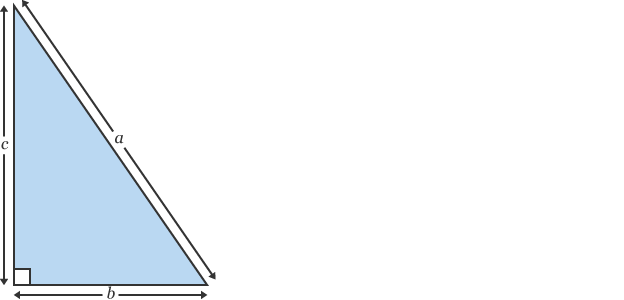
Geometry Formulae
Geometry questions make up an important part of the National 5 Maths course and often appear in both calculator and non-calculator sections of the exam. You’ll be expected to calculate the area, perimeter, circumference and volume of different shapes, as well as solve problems involving right-angled triangles and circles. Understanding when to use each formula is just as important as knowing the formula itself.
Area of a Rectangle
Formula
Area = Length × Width
Or:
A = l × w
Explanation
The area of a rectangle tells you how much space is contained inside the shape. To find the area, simply multiply the length by the width. Remember that both measurements must be in the same units before you calculate the answer.
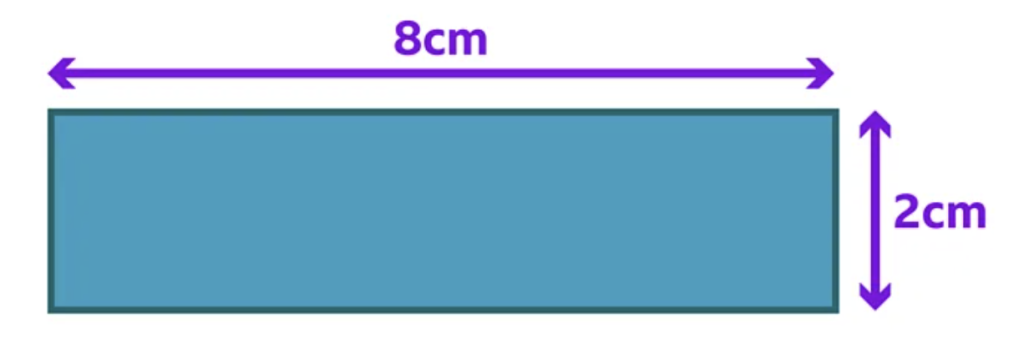
The final answer is always written in square units, such as cm², m² or mm².
Worked Example
A rectangle has:
- Length = 8 cm
- Width = 5 cm
Using the formula:
Area = Length × Width
Area = 8 × 5
Area = 40 cm²
Answer: 40 cm²
Exam Tip
A common mistake is forgetting to include the square unit in your final answer. If the measurements are given in centimetres, your answer should be written as cm², not just cm.
Area of a Triangle
Formula
Area = (Base × Height) ÷ 2
Or:
A = ½bh
Explanation
The area of a triangle is found by multiplying the base by the perpendicular height and then dividing the answer by two. The height must always be measured at a right angle (90°) to the base.
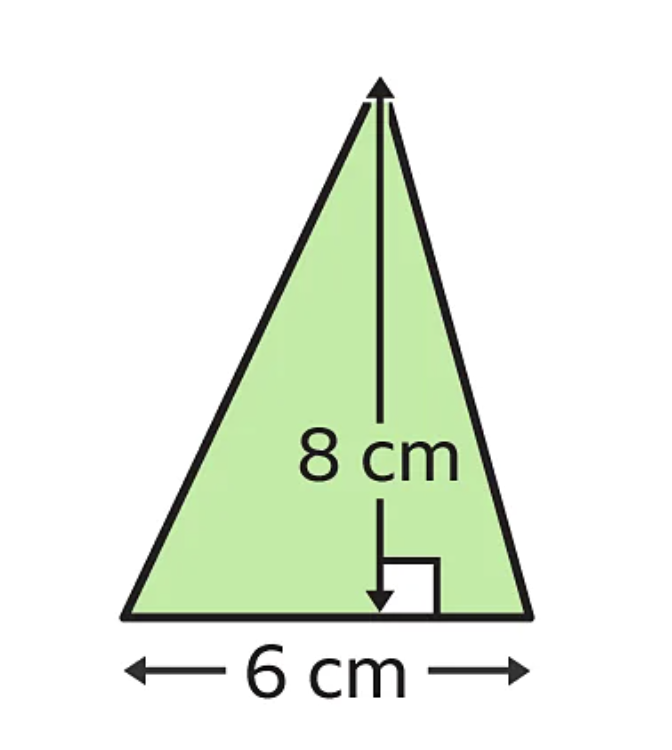
Your final answer should always be written in square units, such as cm² or m².
Trusted Math Tutors in Glasgow: Helping Students Excel in SQA Exams
Worked Example
A triangle has:
- Base = 10 cm
- Height = 6 cm
Using the formula:
Area = (10 × 6) ÷ 2
Area = 60 ÷ 2
Area = 30 cm²
Answer: 30 cm²
Exam Tip
Make sure you use the perpendicular height, not simply the length of one of the triangle’s sides.
Area of a Trapezium
Formula
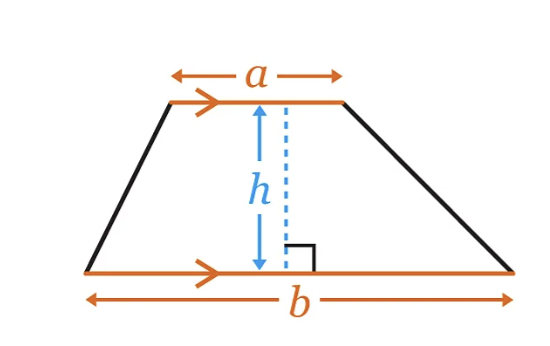
Area = ((a + b) × h) ÷ 2
Where:
- a = first parallel side
- b = second parallel side
- h = perpendicular height
Explanation
To calculate the area of a trapezium, add together the two parallel sides, multiply by the perpendicular height and divide by two.
Remember that the height must always be measured at a right angle to the parallel sides.
Worked Example
A trapezium has:
- Parallel side 1 = 8 cm
- Parallel side 2 = 14 cm
- Height = 5 cm
Using the formula:
Area = ((8 + 14) × 5) ÷ 2
Area = (22 × 5) ÷ 2
Area = 110 ÷ 2
Area = 55 cm²
Answer: 55 cm²
Exam Tip
Only add the parallel sides together. Don’t accidentally include the sloping sides in your calculation.
Circumference of a Circle
Formula
Circumference = 2πr
or
Circumference = πd
Where:
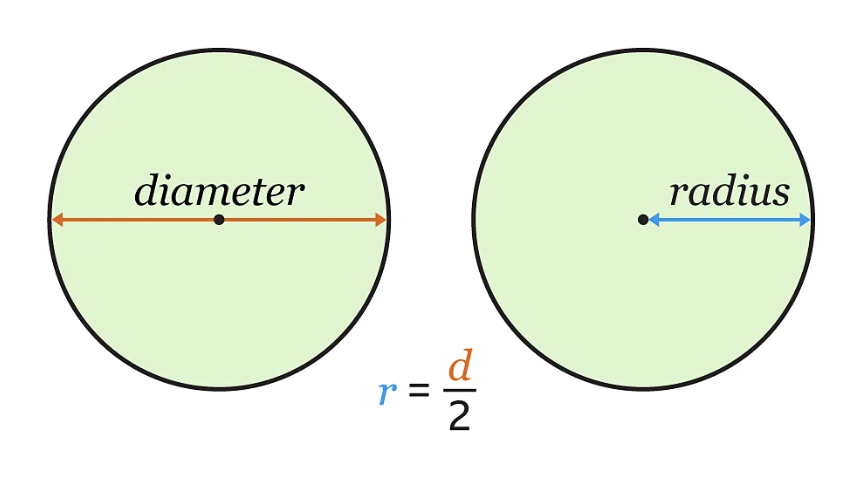
- r = radius
- d = diameter
Explanation
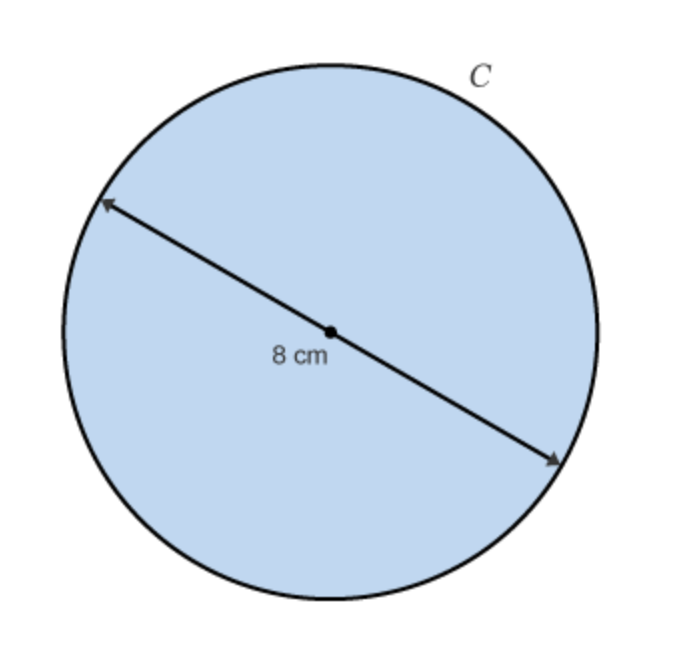
The circumference is the distance all the way around the outside of a circle. If you know the radius, multiply it by 2π. If you know the diameter, simply multiply it by π. Read more on BBC Bitesize here Circumference and area of a circle.
Worked Example
A circle has a radius of 7 cm.
Using the formula:
Circumference = 2 × π × 7
Circumference ≈ 43.98 cm
Answer: 44 cm (to the nearest centimetre)
Exam Tip
Remember that the diameter is twice the radius. Read the question carefully before choosing your formula.
Area of a Circle
Formula
Area = πr²
Where:
- r = radius
Explanation
To calculate the area of a circle, square the radius first and then multiply by π.
The answer is always written in square units.
Worked Example
A circle has a radius of 5 cm.
Using the formula:
Area = π × 5²
Area = π × 25
Area ≈ 78.54 cm²
Answer: 78.5 cm²
Exam Tip
Many students accidentally square π as well. Only the radius is squared.
Circle Theorems – Area of circles and sectors
Volume of a Prism
Formula
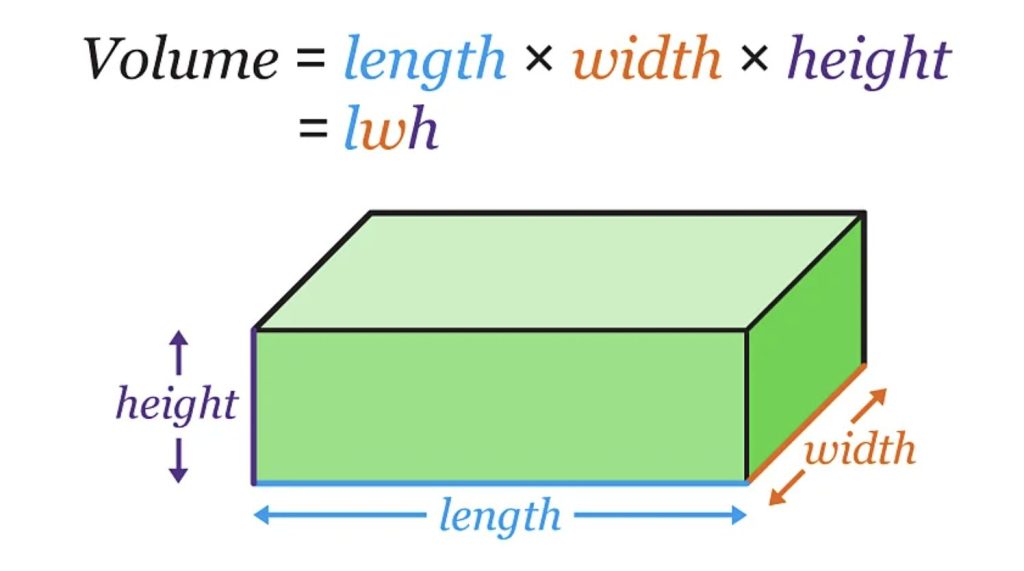
Volume = Cross-sectional Area × Length
Or:
V = A × l
Volume of cylinders and prisms
Explanation
The volume of a prism is found by calculating the area of its cross-section and multiplying it by the prism’s length.
Your answer should always be written in cubic units, such as cm³ or m³.
Worked Example
A prism has:
- Cross-sectional area = 24 cm²
- Length = 9 cm
Using the formula:
Volume = 24 × 9
Volume = 216 cm³
Answer: 216 cm³
Exam Tip
Always calculate the cross-sectional area first before multiplying by the prism’s length.
Surface Area
Formula
Surface Area = Total Area of All Faces
Surface area of cubes and cuboids
Explanation
Surface area is the total area covering the outside of a three-dimensional shape. To find it, calculate the area of every face and add them together.
Different shapes have different methods, so always identify the solid before starting your calculation.
Worked Example
A cube has sides measuring 5 cm.
Area of one face:
5 × 5 = 25 cm²
There are 6 faces.
Surface Area = 25 × 6
Surface Area = 150 cm²
Answer: 150 cm²
Exam Tip
Don’t confuse surface area with volume. Surface area is measured in square units (cm²), while volume is measured in cubic units (cm³).
Common Geometry Symbols
| Symbol | Meaning |
|---|---|
| π | Pi (≈3.14159) |
| cm² | Square centimetres |
| cm³ | Cubic centimetres |
| r | Radius |
| d | Diameter |
| h | Height |
| l | Length |
| w | Width |
When Will Geometry Formulae Appear in the National 5 Maths Exam?
Geometry is one of the core topics assessed in the SQA National 5 Maths exam, meaning there’s a strong chance you’ll encounter geometry questions in both the calculator and non-calculator papers. While the exact questions vary each year, students are regularly expected to apply geometry formulae to solve practical problems involving shapes, measurements and right-angled triangles.
Rather than simply recalling a formula, many exam questions require you to identify which formula is needed, substitute the correct values and show your working clearly. Multi-step questions are also common, where you’ll need to combine several skills to reach the final answer.
Some of the most frequently tested geometry topics include:
- Area of rectangles, triangles and trapeziums
- Circumference and area of circles
- Volume of prisms
- Surface area of three-dimensional shapes
- Pythagoras’ Theorem
- Problem-solving using measurements and scale
To maximise your marks, make sure you understand when to use each formula, not just how to memorise it. Regular practice with National 5 Maths past papers will help you recognise common question styles and improve your confidence ahead of exam day.
Geometry Questions You Could Be Asked
Geometry questions in the National 5 Maths exam are designed to test more than just your ability to remember formulas. You’ll often need to identify the correct formula, substitute the given values, show your working and interpret your answer in the context of the question. Many geometry problems are worth several marks, so showing each step clearly can help you pick up valuable method marks even if your final answer isn’t correct.
Here are some of the most common types of geometry questions you could be asked in your National 5 Maths exam:
Calculate the Area of a Shape
You may be asked to find the area of common shapes such as rectangles, triangles, trapeziums and circles. Some questions involve compound shapes, requiring you to split the diagram into smaller shapes before calculating the total area.
Find the Circumference or Area of a Circle
Circle questions are a regular feature of National 5 Maths exams. Make sure you know when to use the radius and when to use the diameter, and remember to use π (pi) correctly in your calculations.
Work Out the Volume of a Prism
Volume questions usually involve finding the area of a cross-section before multiplying it by the length of the prism. Always check that your final answer is given in cubic units (cm³, m³, etc.).
Calculate the Surface Area of a 3D Shape
Surface area questions require you to calculate the area of every visible face and add them together. Be careful not to miss any faces or confuse surface area with volume.
Use Pythagoras’ Theorem
You’ll often need to calculate a missing side in a right-angled triangle using Pythagoras’ Theorem. Before starting, identify the hypotenuse, as this determines which side should be labelled c in the formula.
Solve Real-Life Geometry Problems
Many National 5 Maths questions place geometry into real-world situations. You could be asked to calculate the amount of paint needed for a wall, the volume of a water tank, the area of a garden or the distance between two points. These questions test your ability to choose the correct formula and apply it accurately.
Work with Compound Shapes
Some of the more challenging questions involve compound shapes. Rather than using one formula, you’ll need to divide the shape into simpler sections, calculate each area separately and combine your answers.
Use the Correct Units
One of the easiest marks to lose is forgetting the correct units. Remember:
- Perimeter and circumference: cm, m, mm
- Area and surface area: cm², m², mm²
- Volume: cm³, m³, mm³
Always check your units before moving on to the next question.
Top Tip for Exam Success
The best way to prepare for geometry questions is by practising a wide range of National 5 Maths past paper questions. The more problems you solve, the easier it becomes to recognise which formula to use and avoid common mistakes under exam conditions.


