
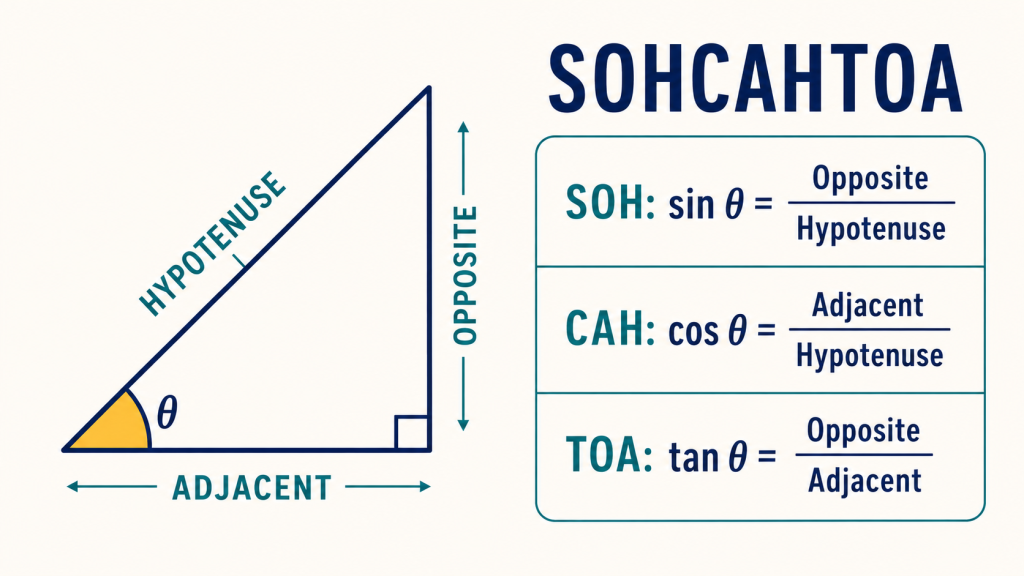
When working with right-angled triangles, you can often use Pythagoras’ theorem or SOHCAHTOA to calculate a missing side or angle. However, these methods cannot be used in exactly the same way when a triangle does not contain a right angle.
For non-right-angled triangles, you may need to use the sine rule or cosine rule instead.
In this National 5 Maths guide, we explain both rules, when to use them and how to apply them through clear worked examples. You will also find practice questions to test your understanding.
If you are looking for a National 5 Maths tutor in Scotland, get in touch with Central Tutors today.
The Cosine Rule and Sine Rule Explained for National 5 Maths
When working with right-angled triangles, you can often use Pythagoras’ theorem or SOHCAHTOA to calculate a missing side or angle. However, these methods cannot be used in exactly the same way when a triangle does not contain a right angle.
For non-right-angled triangles, you may need to use the sine rule or cosine rule instead.
In this National 5 Maths guide, we explain both rules, when to use them and how to apply them through clear worked examples. You will also find practice questions to test your understanding.
What Is the Cosine Rule?
The cosine rule allows you to calculate a missing side or angle in a non-right-angled triangle.
To calculate the length of a missing side, you can use:
a2 = b2 + c2 − 2bc cos(A)
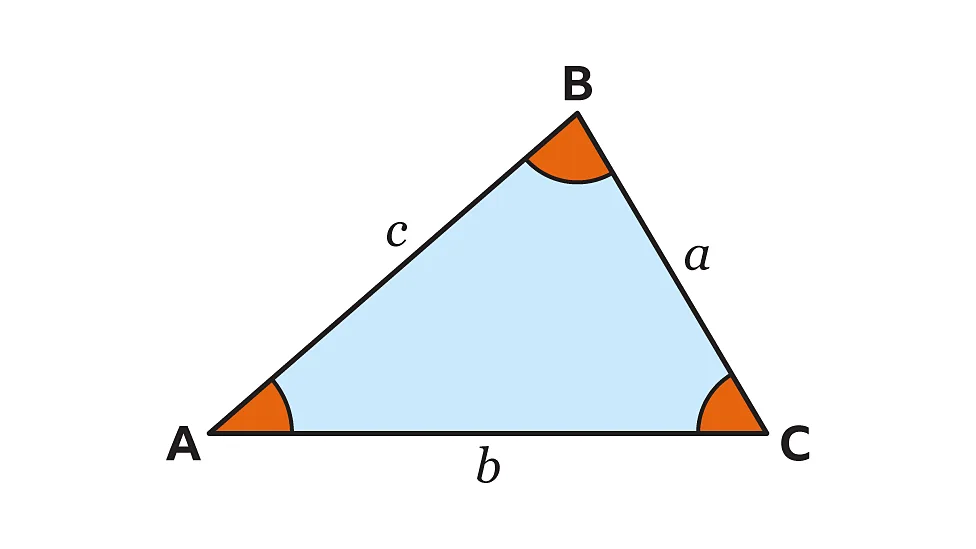
The letters a, b and c represent the sides of the triangle. The capital letters A, B and C represent the angles opposite those sides.
- Side a is opposite angle A.
- Side b is opposite angle B.
- Side c is opposite angle C.
It is important to match each side with its opposite angle correctly before beginning your calculation.
When Should You Use the Cosine Rule?
You can normally use the cosine rule when you are given either:
- Two sides and the angle between them
- All three sides of a triangle
If you know two sides and the included angle, you can use the cosine rule to calculate the third side.
If you know all three sides, you can rearrange the cosine rule to calculate one of the angles.
What is an included angle?
The included angle is the angle located between the two known sides.
For example, if you know sides b and c, the included angle is A. This is because angle A sits between sides b and c.
How to Find a Missing Side Using the Cosine Rule
Suppose a triangle has:
- Side b = 7 cm
- Side c = 10 cm
- Angle A = 60°
We want to calculate side a.
Step 1: Write down the cosine rule
a2 = b2 + c2 − 2bc cos(A)
Step 2: Substitute the known values
a2 = 72 + 102 − (2 × 7 × 10 × cos 60°)
Step 3: Calculate the squared values
a2 = 49 + 100 − (140 × cos 60°)
We know that:
cos 60° = 0.5
Therefore:
a2 = 149 − 70
a2 = 79
Step 4: Find the square root
The formula has given us a2, but we need to calculate a. We therefore take the square root of 79:
a = √79
a = 8.888…
Rounded to two decimal places:
a = 8.89 cm
Remember to include the correct unit in your final answer.
How to Find an Angle Using the Cosine Rule
If you know all three side lengths, you can rearrange the cosine rule to find an angle.
The rearranged formula is:
cos(A) = b2 + c2 − a2 2bc
To calculate angle A, you then use inverse cosine:
A = cos−1 ( b2 + c2 − a2 2bc )
Suppose a triangle has:
- Side a = 13 cm
- Side b = 8 cm
- Side c = 11 cm
We want to calculate angle A, which is opposite side a.
Step 1: Write down the rearranged formula
cos(A) = b2 + c2 − a2 2bc
Step 2: Substitute the values
cos(A) = 82 + 112 − 132 2 × 8 × 11
Step 3: Calculate the squared values
cos(A) = 64 + 121 − 169 176
cos(A) = 16 176
cos(A) = 0.0909…
Step 4: Use inverse cosine
A = cos−1(0.0909…)
A = 84.784…°
Rounded to one decimal place:
A = 84.8°
Make sure your calculator is set to degrees rather than radians before completing trigonometry calculations.
What Is the Sine Rule?
The sine rule is another method used to calculate missing sides and angles in non-right-angled triangles.
The formula can be written as:
a sin(A) = b sin(B) = c sin(C)
This version is usually helpful when calculating a missing side.
When calculating a missing angle, it can be easier to turn each fraction upside down:
sin(A) a = sin(B) b = sin(C) c
Both versions describe the same relationship. Once again, each side must be paired with its opposite angle.
When Should You Use the Sine Rule?
You can normally use the sine rule when you know:
- Two angles and one side
- Two sides and an angle opposite one of them
The key requirement is having at least one complete side-and-angle pair. This means that you know the length of a side and the size of the angle directly opposite it.
If you do not have a complete side-and-angle pair, the cosine rule may be more appropriate.
How to Find a Missing Side Using the Sine Rule
Suppose a triangle has:
- Angle A = 40°
- Side a = 8 cm
- Angle B = 65°
We want to calculate side b.
Step 1: Select the relevant parts of the sine rule
a sin(A) = b sin(B)
Step 2: Substitute the known values
8 sin 40° = b sin 65°
Step 3: Rearrange the formula
b = 8 sin 65° sin 40°
Step 4: Calculate the answer
b = 11.279…
Rounded to two decimal places:
b = 11.28 cm
How to Find an Angle Using the Sine Rule
Suppose a triangle has:
- Side a = 7 cm
- Angle A = 35°
- Side b = 6 cm
We want to calculate angle B.
Step 1: Write down the relevant formula
sin(A) a = sin(B) b
Step 2: Substitute the values
sin 35° 7 = sin(B) 6
Step 3: Rearrange the formula
sin(B) = 6 sin 35° 7
sin(B) = 0.4916…
Step 4: Use inverse sine
B = sin−1(0.4916…)
B = 29.45…°
Rounded to one decimal place:
B = 29.5°
Sine Rule or Cosine Rule: Which Should You Use?
Choosing the correct rule is an important part of solving triangle questions.
| Information provided | Rule to use |
|---|---|
| Two sides and the included angle | Cosine rule |
| All three sides | Cosine rule |
| Two angles and one side | Sine rule |
| Two sides and an angle opposite one of them | Sine rule |
| A right-angled triangle | Pythagoras or SOHCAHTOA |
A quick way to choose
-
Is the triangle right-angled?
If it is, consider Pythagoras or SOHCAHTOA. -
Do I know all three sides?
Use the cosine rule to calculate an angle. -
Do I know two sides and the angle between them?
Use the cosine rule to calculate the remaining side. -
Do I have a complete opposite side-and-angle pair?
You can probably use the sine rule.
How to Label a Non-Right-Angled Triangle
Correctly labelling the triangle will make the calculation much easier.
Angles are normally represented by capital letters:
A, B, C
The opposite sides use the corresponding lowercase letters:
a, b, c
Therefore, if a side measures 12 cm and it is opposite angle B, that side should be labelled b = 12.
A common mistake is to assume that the side next to angle A should also be called a. This is incorrect. Side a must be directly opposite angle A.
Finding a Missing Angle Before Using the Sine Rule
Sometimes you will be given two angles and one side, but the missing side is not paired with either of the given angles.
In this situation, you may need to calculate the third angle first. The angles inside any triangle add up to 180°.
For example, if:
A = 48°
B = 72°
Then:
C = 180° − 48° − 72°
C = 60°
You can then use the newly calculated angle as part of the sine rule.
The Ambiguous Case of the Sine Rule
When using the sine rule to calculate an angle, it is sometimes possible for a triangle to have two valid answers.
This happens because:
sin(θ) = sin(180° − θ)
For example, if your calculator gives an angle of 40°, another possible angle may be:
180° − 40° = 140°
Whether both answers are valid depends on the other sides and angles in the triangle.
You should check that:
- Every angle is greater than 0°.
- The three angles add up to 180°.
- The longest side is opposite the largest angle.
- The proposed triangle is geometrically possible.
Common Sine and Cosine Rule Mistakes
Pairing a side with the wrong angle
In the sine rule, each side must be paired with the angle directly opposite it. Check your diagram carefully before substituting values into the formula.
Using the wrong triangle rule
The sine rule is normally used when you have a complete opposite side-and-angle pair. The cosine rule is normally used when you have two sides and the included angle, or all three sides.
Using the wrong angle in the cosine rule
When finding a missing side, the angle in the cosine rule must be the angle opposite the missing side. It should also be the angle between the other two sides used in the calculation.
Forgetting inverse sine or inverse cosine
If your calculation gives you:
sin(A) = 0.6
You have not yet found the angle. You need to use inverse sine:
A = sin−1(0.6)
Using radians instead of degrees
For National 5 triangle questions, your calculator should usually be in degree mode. Look for a small “D” or “DEG” on the calculator display.
Rounding too early
Keep the full calculator value during your working and round only your final answer. Rounding during an earlier step can make your final answer less accurate.
Forgetting to find the square root
When using the cosine rule to find a side, you initially calculate a2. You must then take the square root to find a.
Leaving out units
Lengths should have an appropriate unit, such as centimetres or metres. Angles should include the degree symbol (°).
National 5 Sine and Cosine Rule Practice Questions
Question 1: Cosine rule for a missing side
A triangle has side lengths b = 6 cm and c = 9 cm. The angle between them is 50°.
Calculate the length of side a, giving your answer to two decimal places.
Question 2: Cosine rule for an angle
A triangle has the following side lengths:
a = 10 cm, b = 7 cm, c = 8 cm
Calculate angle A, giving your answer to one decimal place.
Question 3: Sine rule for a missing side
In a triangle:
A = 42°, a = 9 cm, B = 71°
Calculate side b, giving your answer to two decimal places.
Question 4: Sine rule for an angle
In a triangle:
A = 50°, a = 12 cm, b = 9 cm
Calculate angle B, giving your answer to one decimal place.
Question 5: Find an angle before using the sine rule
A triangle has:
A = 47°, B = 68°, a = 10 cm
Calculate angle C, then calculate side c. Give the length to two decimal places.
Practice Question Answers
Answer 1
a2 = 62 + 92 − (2 × 6 × 9 × cos 50°)
a2 = 36 + 81 − (108 × cos 50°)
a2 = 47.579…
a = √47.579…
a = 6.90 cm
Answer 2
cos(A) = 72 + 82 − 102 2 × 7 × 8
cos(A) = 13 112
A = cos−1 ( 13 112 )
A = 83.3°
Answer 3
9 sin 42° = b sin 71°
b = 9 sin 71° sin 42°
b = 12.72 cm
Answer 4
sin 50° 12 = sin(B) 9
sin(B) = 9 sin 50° 12
B = sin−1 ( 9 sin 50° 12 )
B = 35.1°
Answer 5
C = 180° − 47° − 68°
C = 65°
10 sin 47° = c sin 65°
c = 10 sin 65° sin 47°
c = 12.39 cm
Frequently Asked Questions
What is the cosine rule?
The cosine rule is a formula used to calculate missing sides and angles in non-right-angled triangles. It is particularly useful when you know two sides and the angle between them, or all three sides.
What is the formula for the cosine rule?
To calculate a missing side, use:
a2 = b2 + c2 − 2bc cos(A)
To calculate angle A, use:
A = cos−1 ( b2 + c2 − a2 2bc )
What is the sine rule?
The sine rule connects the sides of a triangle with the sines of their opposite angles:
a sin(A) = b sin(B) = c sin(C)
What is the difference between the sine and cosine rules?
The sine rule requires a known opposite side-and-angle pair. The cosine rule is usually used when you know all three sides or two sides and the angle between them.
Can the sine rule be used on a right-angled triangle?
Yes, the sine rule can work with a right-angled triangle. However, SOHCAHTOA or Pythagoras’ theorem will often provide a simpler method at National 5 level.
How do I know which side is a?
Side a is the side directly opposite angle A. Similarly, side b is opposite angle B, and side c is opposite angle C.
Should my calculator be in degrees or radians?
For most National 5 Maths triangle questions, your calculator should be set to degrees. You can normally confirm this by looking for “D” or “DEG” on the display.
Build Your Confidence in National 5 Maths
The sine rule and cosine rule can appear complicated at first, but the process becomes much easier once you can recognise which formula to use. Looking for National 5 maths past papers? National 5 Maths Past Papers: Free SQA Exam Papers & Revision Resources.
Remember to:
- Label each side and its opposite angle
- Identify the information provided
- Choose the correct rule
- Substitute the values carefully
- Keep the full calculator value until the end
- Include units in your final answer
If your child is struggling with trigonometry or another area of National 5 Maths, Central Tutors can provide focused, one-to-one support.
Our experienced maths tutors help students understand the reasoning behind each method, correct gaps in their knowledge and approach exams with greater confidence.
Contact Central Tutors to learn more about our National 5 Maths tutoring.


