Introduction
Simultaneous equations are a fundamental concept in mathematics that often come up in National 5 exams in Scotland. They are equations that have two or more unknown variables and need to be solved together to find the values of those variables. This post will provide a guide on how to solve simultaneous equations using different methods, tips and tricks for solving them and some practice problems.
What are simultaneous equations?
Simultaneous equations are equations that have two or more unknown variables and need to be solved together to find the values of those variables. They are written in the form of ax + by = c, where a, b, and c are constants, and x and y are the unknown variables.
Looking for a maths tutor in Scotland? Get in touch with Central Tutors now
These equations are a fundamental concept in mathematics that are frequently encountered in National 5 exams in Scotland. Whether you are studying for your exams or providing private tutoring, understanding how to solve simultaneous equations is crucial for success in math. Simultaneous equations involve multiple variables and equations that need to be solved at the same time, and can be used to model a wide range of phenomena across different fields, from physics and engineering to economics and computer science.
A Simple Example of Simultaneous Equations
Simultaneous equations are two equations containing the same unknown values. They are solved together to find one value for each unknown.
For example:
x + y = 10
x − y = 2
The values that make both equations correct are:
x = 6
y = 4
We can check this by putting the values back into both equations:
6 + 4 = 10
6 − 4 = 2
Both equations are correct, so the solution is x = 6 and y = 4.
In this guide, we will walk you through the process of solving these equations step by step, using different methods like the substitution method, elimination method, and graphical method. We will also provide practice problems and tips for checking your solutions, so you can become confident in solving simultaneous equations and ace your National 5 exams in Scotland. So, let’s get started!
Why Are Simultaneous Equations Important in National 5 Maths?
Simultaneous equations appear regularly in National 5 Maths because they test your ability to:
- Solve algebraic problems
- Rearrange equations
- Use logical reasoning
- Apply mathematical methods accurately
Understanding simultaneous equations also provides a foundation for Higher Maths and many STEM-related subjects.
You may find some of our other blog posts useful:
Simultaneous Equations Made Easy: Tips for National 5 Students in Scotland
Simultaneous Equations – what they are and how to use them

Method 1: Solving Simultaneous Equations Using Elimination
The elimination method involves removing one variable so that you can solve for the other.
Example
x + y = 10
x – y = 2
Step 1: Add the Equations Together
(x + y) + (x – y) = 10 + 2
2x = 12
Step 2: Solve for x
x = 6
Step 3: Substitute Back Into One Equation
6 + y = 10
y = 4
Answer
x = 6
y = 4
Method 2: Solving Simultaneous Equations Using Substitution
The substitution method works by expressing one variable in terms of another.
Example
y = 2x + 1
x + y = 10
Step 1: Substitute
Replace y in the second equation:
x + (2x + 1) = 10
Step 2: Simplify
3x + 1 = 10
3x = 9
x = 3
Step 3: Find y
y = 2(3) + 1
y = 7
Answer
x = 3
y = 7
Simultaneous Equations in Word Problems
National 5 exams often include worded questions.
Example
A cinema sold 100 tickets.
Adult tickets cost £8.
Child tickets cost £5.
The total revenue was £650.
How many adult and child tickets were sold?
Let:
a = adult tickets
c = child tickets
Create two equations:
a + c = 100
8a + 5c = 650
These can then be solved using elimination.
National 5 Example Question
Here’s the BBC Bitesize page for National 5 Simultaneous Equations.
Solve:
2x + y = 13
x – y = 2
Step 1: Add the Equations
(2x + y) + (x – y) = 13 + 2
3x = 15
x = 5
Step 2: Substitute Back
5 – y = 2
y = 3
Answer
x = 5
y = 3
Here’s an example of a simultaneous equation:
3x + 4y = 10 2x – y = 4
To solve this equation, we need to find the values of x and y that satisfy both equations.
Common Mistakes Students Make
Forgetting to Eliminate Correctly
Always check that one variable cancels completely.
Sign Errors
Take care with positive and negative numbers when adding or subtracting equations.
Not Substituting Back
Once you find one variable, remember to calculate the second.
Poor Working Out
Examiners award marks for method as well as the final answer.
Show every step clearly.
Methods for solving simultaneous equations
Simultaneous equations, or systems of equations, can be challenging to solve, especially when there are multiple variables involved. Fortunately, there are several methods available that can help you find the solution to a system of simultaneous equations. In this guide, we will explore three of the most commonly used methods for solving simultaneous equations: the substitution method, the elimination method, and the graphical method. Each method has its advantages and disadvantages, and the best method to use depends on the particular problem at hand. By learning these methods, you will be equipped with the tools to tackle even the most complex simultaneous equations problems.
Substitution method
In the substitution method, we solve one of the equations for one variable and then substitute that expression into the other equation to solve for the other variable. Here’s an example:
Example: Solving Simultaneous Equations by Substitution
Solve these two equations:
x + y = 10
x − y = 2
First, rearrange the second equation to find x:
x = y + 2
Now substitute y + 2 in place of x in the first equation:
(y + 2) + y = 10
Simplify:
2y + 2 = 10
Subtract 2 from both sides:
2y = 8
Divide both sides by 2:
y = 4
Now substitute y = 4 into the second equation:
x − 4 = 2
Therefore:
x = 6
The solution is:
x = 6 and y = 4
Check the answer:
6 + 4 = 10
6 − 4 = 2
Both equations are correct, so the solution is x = 6 and y = 4.
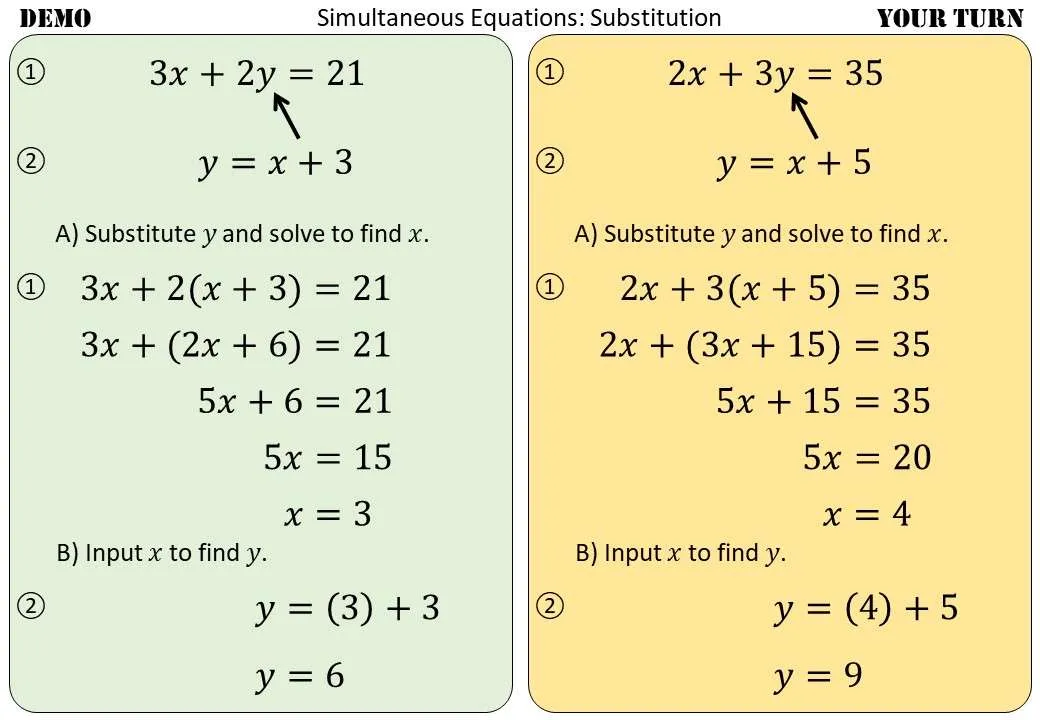
This example is from Go Teach Maths
Elimination Method
In the elimination method, we add or subtract the equations to remove one of the unknown values.
Solve these equations:
x + y = 10
x − y = 2
Add the two equations together:
(x + y) + (x − y) = 10 + 2
The +y and −y cancel each other out:
2x = 12
Divide both sides by 2:
x = 6
Now substitute x = 6 into the first equation:
6 + y = 10
Subtract 6 from both sides:
y = 4
Therefore, the solution is:
x = 6 and y = 4
Check the answer:
6 + 4 = 10
6 − 4 = 2
Both equations are correct, so the solution is x = 6 and y = 4.
Graphical method to solve simultaneous equations
In the graphical method, we plot both equations on the same graph and find the point of intersection. Here’s an example:
x+y=6
−3x+y=2

When we draw the graphs of these two equations,
we can see that they intersect at (1, 5).
So the solution to the simultaneous equations is:
x = 1 and y = 5
We can prove this is the solution by substituting the values into the original equations:
x = 1, y = 5
Tips for solving simultaneous equations
a. Set up the equations correctly: Make sure to write the equations in standard form, where the variables are on the left side of the equation and the constants are on the right side. Also, make sure to write the equations in a consistent order.
b. Check your solutions: Always check your solutions by plugging them back into the original equations to make sure they satisfy both equations.
c. Practice with different types of simultaneous equations: Practice solving different types of simultaneous equations to get familiar with the different methods and gain confidence.
Practice problems
Here are some practice problems to help you practice solving simultaneous equations:
a. 2x + 3y = 7 x – 4y = -5
b. 4x – 3y = 5 2x + 5y = 11
c. 5x + 2y = 13 3x – 4y = -5
d. x + y = 7 3x – 2y = 1
Answers:
a. (-1,2) b. (1,2) c. (2,3) d. (3,4)
Make sure to check your answers by substituting them back into the original equations to ensure that they satisfy both equations.
Revision Tips for Simultaneous Equations
- Practise both elimination and substitution methods.
- Show all working clearly.
- Check your answers by substituting them back into both equations.
- Complete past National 5 Maths papers.
- Focus on accuracy rather than speed.
The more simultaneous equations you solve, the easier they become.
Frequently Asked Questions
What are simultaneous equations?
Simultaneous equations are two or more equations containing the same variables that must be solved together.
Which method is best?
For most National 5 questions, elimination is usually the quickest method, although substitution is often useful when one equation is already rearranged.
Do simultaneous equations appear in National 5 Maths exams?
Yes. Simultaneous equations are a common National 5 Maths topic and students should be comfortable solving them using both elimination and substitution.
How can I improve at simultaneous equations?
Regular practice, checking your answers, and working through past-paper questions are the best ways to improve.
Conclusion
In conclusion, simultaneous equations are a crucial concept in mathematics that comes up frequently in National 5 exams in Scotland. To solve simultaneous equations, we can use different methods like the substitution method, elimination method, and graphical method. It’s important to set up the equations correctly, check our solutions, and practice with different types of simultaneous equations to become confident in solving them. By following the tips and techniques outlined in this post, you can become proficient in solving simultaneous equations and succeed in your National 5 exams in Scotland. If you or your child wants extra help in National 5 maths then get in touch with us today.